After yesterday, I suppose I should have predicted how tired I would feel waking up, but I underestimated by a long way!
Muscles I'd forgotten even existed in my arms and my right (i.e. non-broken) leg were sore as soon as I woke, but I managed to wash, dress and get down to breakfast in the hotel this morning.
The Travelodge staff were excellent at breakfast, they helped me to a table and collected my breakfast for me, then helped me to reception to check out and out onto City Road to head back for another day with TheSite.org Leaders.
I was astonished, however, that whilst I was eating breakfast, someone moved me out of their way! I suppose I was taking up a bit of space in a wheelchair, and he wanted to get past, so he pushed me forward into the table. It took me a second to register what had happened, I spilled the drink I had in my hand.
I thought I was running late for the morning session, and admittedly I suppose I was a bit cocky, so I tried to make my way along City Road on my own. It's a five-minute walk, but took me about half an hour even with some help from nice people along the way. Again, one or two people took it upon themselves to move me in the wheelchair without asking, or telling me what they were going to do. I admit that I was struggling, but I was embarrassed to be struggling, and I felt even more embarrassed when I was just moved out of the way like an inanimate object.
I wouldn't attempt something like that again - it was a pretty stupid idea - but I'll admit I was pretty pleased with myself when I did finally make it to the office.
I had great fun in the morning with fellow-Leaders Katie and Tolu leading a session on developing and strengthening the Leaders' network to achieve even more in the next twelve months than we have in the first year. We played a game at the beginning of our session where we asked people to label each other with a range of tasks they've completed in their time as volunteers. I had my labels collected on my cast - which had remained stubbornly undecorated over the previous ten days!
Later on, some of the girls took it a step further, so that before I left for church I had collected three very sweet messages!
Thanks, Rochelle, Rach and Sophie!
It always sucks to say goodbye at the end of the weekenders, but I hope we're all pretty fired up and looking forward already to the next one!
I was lucky again to have some fab support getting to church, in the form of a lift from Debbie. She wrestled my heavy and clunky wheelchair single-handedly into the car and braved the wrath of Camden's many over-keen traffic wardens to get me there. I honestly wouldn't have managed it otherwise - I couldn't have either got a cab or a bus without pretty serious difficulties.
Was lovely to be back at church after some time off - and I was really pleased that I managed to get up to celebrate communion and pray with some of the congregation against the odds. I had another lift home from one of the deacons, and am now thoroughly exhausted.
Sermon given at MCC North London on the 31st October, 2010 for All Saints Day.
Most of you know, I have just moved to Oxford to start a post-graduate degree in theology. I’m studying in an Anglican seminary with a strong Catholic tradition, so it’s been something of a culture shock, to say the least!
In the past four weeks I have observed saints’ days, sung psalms – and worse, sung them in Latin – and I’m beginning to understand things that have never been part of my worship before. When I arrived here, I was slightly surprised to see a long list on the chapel noticeboard of the saints’ days and their observances. I’m a good child of the Reformation, I wasn’t sure I could cope…
Today is the Sunday before All Saints’ Day, which falls tomorrow, and something that I have found quite striking since I’ve been here is really how much there is to learn from the lives of the saints.
In the past month, there are Christians all over the world who have celebrated feast days including St. Theresa of Avila, Ss. Simon and Jude, St. Luke the Evangelist and my current favourite St. Frideswide, who is the patron saint both of the city and University of Oxford.
St. Simon and St. Jude – the patron saint of lost causes – were two of the twelve named apostles of Jesus. Very little has been written in the scriptures about either of them but tradition, through the extra-canonical ‘Acts of Simon and Jude’ has them as early missionaries throughout the Middle East. They would, like St. Paul, have travelled as peripatetic preachers and evangelists. They are venerated as the founding saints of the Armenian Apostolic church and were martyred at around the same time as St. Paul on the site that is now Beirut, in the Lebanon.
St. Frideswide – it’s a good Saxon name, if you wondered – was local to Oxford, and has become the patron saint of the city and its University. She founded a priory in the 8th century, which was destroyed by fire in the 11th century along with its chronicles, so the records of its early life are lost. I was rebuilt around 1122 and then was dissolved under the Reformation of Henry VIII in the 1520s. Tradition, and Anglo Saxon writings, say that she had taken a vow of chastity and entered holy orders, but was pursued by a local nobleman determined to marry her. She hid in a pigsty to escape him and was saved when he was struck blind (or possibly fell from his horse and broke his neck – sadly this was in the days before reliable BBC coverage). Either way, she went on to live according to her vows and to found Christ Church College, Oxford.
St. Teresa of Avila was a Carmelite nun in sixteenth century Spain. She joined a holy order having been fascinated from an early age with the religious life and fell grievously ill whilst cloistered. During her illness, which lasted for many years, she had increasingly vivid visions of the glory of heaven. In response to these visions, she became determined always to live out her faith and express her convictions through practical means. She made this resolution as a response what she – along with the Protestant reformers working throughout Europe – saw as the increasing corruption and indulgence in the Catholic Church. She withdrew into a new order which took seriously its vows of seclusion and poverty but also suffered serious persecution in a time of significant religious confusion. She eventually died, presumably of the illness she had suffered since she was a young woman, having devoted the last years of her life to travelling southern Spain founding new convents.
'Blessed are you who are poor, for yours is the kingdom of God.
'Blessed are you who are hungry now, for you will be filled.
'Blessed are you who weep now, for you will laugh.
'Blessed are you when people hate you, and when they exclude you, revile you, and defame you on account of the Son of Man. Rejoice on that day and leap for joy, for surely your reward is great in heaven; for that is what their ancestors did to the prophets.'
Luke – whose life and work was also celebrated in a feast this month – records these as the words of Jesus to a large crowd of his disciples. Many of the people gathered there were asking for healing in body or spirit, some had already been healed, and all were listening raptly to the words of Jesus. There is no less diversity in reasons for seeking Jesus today than there were on that day in Judea (southern Israel) two millennia ago. The words he spoke to them then have comforted people throughout the centuries and inspired incredible works.
'Blessed are you who are poor, for yours is the kingdom of God. ‘Blessed are you who are hungry now, for you will be filled.
Blessed are you, who follow the example of Jesus Christ and his twelve apostles, the first Christian saints, including Simon and Jude, who left everything they had and followed him. Blessed is the person who goes without, who is impoverished for the sake of the Gospel or for their brothers and sisters in Christ.
And, because we should also take this at face value, blessed are you who are suffering poverty because of the actions of others.
'Blessed are you who weep now, for you will laugh.'
Blessed are you who mourns for the state of the world, or you who has lost something you thought was your whole life. Blessed are you who are suffering in your mind and spirit, who are worn out by a world that seems to be so far from being the good it was created to be.
St. Teresa, as well as suffering from physical illness, suffered from crippling depressions at times in her life. She felt abandoned by God, and believed herself unworthy of God’s care. She spoke repeatedly of how desperately miserable this made her but later in life, true to the words of scripture, she found deep joy in a life of prayer, and reassurance in the love of God. She said,
"Mental prayer in my opinion is nothing else than an intimate sharing between friends; it means taking time frequently to be alone with him who we know loves us. The important thing is not to think much but to love much and so do that which best stirs you to love. Love is not great delight but desire to please God in everything … Prayer is an act of love, words are not needed. Even if sickness distracts from thoughts, all that is needed is the will to love."
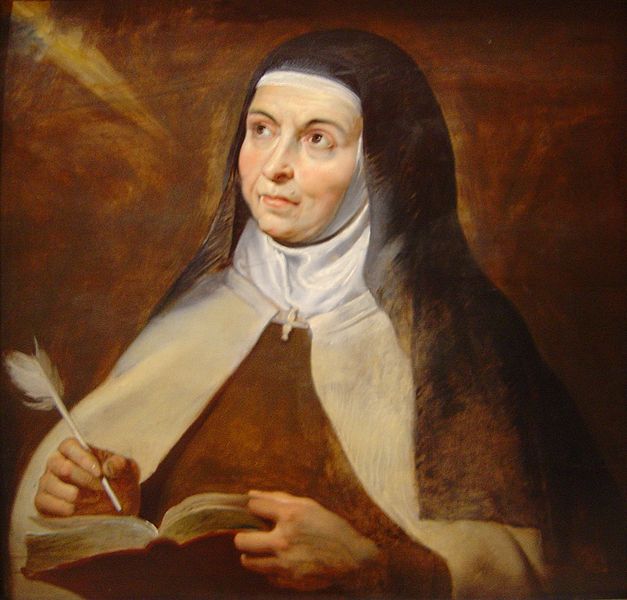
St. Teresa of Avila, by Peter Paul Reubens, 1615 in the Kunsthistorisches Museum, image from Wikimedia Commons
'Blessed are you when people hate you, and when they exclude you, revile you, and defame you on account of the Son of Man. Rejoice on that day and leap for joy, for surely your reward is great in heaven; for that is what their ancestors did to the prophets.
One thing the saints seem to have in common is a triumph over adversity. They share this with the great prophets of the Old Testament – Elijah sulking under trees, Ezekiel exiled to Babylon, Job afflicted with sores and illnesses we cannot begin to imagine. The lives of these great people – whether they are recorded in Scripture or handed down through centuries of tradition – are an inspiration to all who hear them because they speak to an eternal truth and that truth is at the heart of the beatitudes.
What makes reading and learning about saints so wonderful is that, although they are exemplary, they are all human. They suffer illnesses of body, mind and spirit, just like we do. They face the difficult calling to live lives worthy of the God who created them, just like we do. And sometimes they get it wrong, just like we do. When Paul wrote his letter to the Ephesians, I don’t suppose he imagined a church culture where people are named saints and recognised annually for their contribution to the Christian life, but I don’t suppose he’d disapprove. When he congratulates the Ephesians on their love for all the saints, he is talking of their reverence for those who have walked in the way of Christ before them. He is acknowledging that within the body of Christ there are many individuals performing their own functions and living their own way, and we can all learn something from observing others.
When we commit to a Christian way of living we commit to a life of learning from experience. Just as we know from experience the truth from tonight’s Gospel reading that all things – the good and the bad – are transient and must not be taken for granted, so we learn from observing the lives of others how we are to respond to the changing circumstances of our lives. In the lives of the saints we see how to be generous when times are good, and humbly give to others. We see how to find courage and hope after a time of darkness. We learn how important it is to stay committed to God in word, thought and deed and in the sure and certain hope that God’s love endures forever.
I’ll leave you with a thought that is expressed in MCC churches throughout the world when we welcome new members into our congregation. When you meet someone new,
"remember that they will have as much to teach you as you will have to teach them."
People are fond of seeing contradictions in the Bible, particularly in the ways that God is depicted. We see one God in the Old Testament - vengeful, demanding, jealous, quick to smite people who cause problems - and another in the New - loving, gracious, quick to reconcile to humanity. We put Jesus, and the Holy Spirit, automatically into this second category of aspects of God, we believe in Jesus as 'meek and mild', a lover not a fighter.
That's why the gospel reading we heard on Sunday (Luke 12:49-56) is so challenging; it puts Old Testament imagery into a New Testament context. In other words, this week's reading challenges the tendency we have to anthropomorphise God. People are generally pretty limited. We are contradictory, that's undoubted, but we are a mere 'image' of God, a reflection or a shadow, incapable of being as God is.
It is precisely because we are so limited that it is hard for us to comprehend how much more God is than we are. We try to use human language to describe the divine. We use words like 'loving', and understand them in the same way we would if we were to talk about other humans. We cannot ever comprehend how much love God has for the created world. So, too, when we talk about God as 'angry'. We can only understand so much anger at one time, before our perception is weakened and limited. And how much harder is it to truly understand the fact that God not only has the capacity for all the emotion we do, but can experience several at once in a way that the human mind finds contradictory?
And yet, to me, it seems that this is the very essence of God, one of the things that makes God divine and not human. St. Augustine of Hippo, as ever, had a lot to say on the subject. The core of his thinking, though is this; if the Trinity is indeed composed of three beings who are interdependent but also distinct, then it is possible for each of them to have attributes that are not part of the other. However, for the human mind to truly comprehend the depth and breadth of God as Trinity is impossible, we can but pray for enough understanding to get a glimpse of the truly awesome power and nature of God.
"We believe that Parent, Son and Holy Spirit are one God, maker and ruler of every creature, and that "Parent" is not "son", nor "Holy Spirit" "Parent" or "son"; but a trinity of mutually related persons, and a unity of equal essence. So let us attempt to understand this truth, praying that he who we wish to understand would help us in doing so, so that we can set out whatever we thus understand with such careful reverence so that nothing unworthy is said."
What he is saying here is that we should not be surprised to see what look like contradictions in the nature of God, because all things come from God and are of one of the beings of the Trinity. When we find a passage in the gospels that challenges our understanding of what Jesus the son is, we should draw near to God in prayer and ask for true understanding to allow us to speak of God's infinite nature.
Of all the names we use for God, the one I like the best is simply "I AM", because it reminds us that sometimes there is no need to describe God with human attributes, but simply to acknowledge that God is.
I haven't done this for a while, so I thought I would link you to people who blog interesting things and are lovely.
Here's a few for starters (in no particular order);
Fashion Launderette is my cousin Milly's blog. Here she tells everyone in the world how she manages to look so fabulous so much of the time...
Miss Hilton Ink is Milly's equally fabulous and talented sister, who is a brilliant artist and works caring for young people with autism and other challenging behaviour. (I think the creative traits must be on the Hilton side, my sister picked them up but I didn't so much!)
NOLA Noodlings is the Big Easy MCC's blog live from New Orleans, Louisiana by the lovely Pastor Clinton.
Through Myself and Back Again is a life-in-general blog by a friend of mine, who tweets and is visible on Ouch as @lilwatchergirl, and is a research student working on disability and inclusivity in Christianity.
27% is The Girl-belonging-to-lilwatchergirl's blog about how she deals with her father's illness.
Two Mummies are Better Than None is Louise's blog about how she and C. are navigating the stormy seas of the UK adoption process as a gay couple.
At the YLGC meeting yesterday, we talked about the importance of sharing experiences, so I hope that my sharing others' here is interesting to you.
I am part of YLGC - Young LGBT Christians - and involved in co-ordinating some of the activities of the group. We received an email from a Christian studying the relationship between Christianity and homosexuality for a school project and asking how we reached the conclusion that we could live as openly gay Christians. This is an email I sent in response.
Hi,
I think you might get a couple of replies from members of YLGC, as we thought that we wouldn't be able to give 'standard' answers to your questions. I do think it's fantastic that you've been given the opportunity to explore this at school.
From my perspective, I think the easiest thing I can do is to try to explain a little about who I am, and how I came to the views I hold today. I'll try not to bore you with my life story, though!
I'm 24, live in London and I have an archaeology degree from UCL in London. I spent a year working for the students' union after I graduated and now work for Waterstone's in the history department of a university branch. I'm also student clergy in the United Fellowship of Metropolitan Community Churches, based at MCC North London, and I've been accepted to Oxford University to study for a Postgraduate Diploma in Theology starting in October. I'm also in a relationship with a woman; we've been together for three months and are monogamous.
When I was young, until I was five, my family attended church. Mum was raised a Christian, but we stopped going when we moved house. I don't remember much from that time, other than how to make a palm tree from a roll of newspaper!
Other than six months or so going to school with a friend when I was ten, I didn't really have much to do with church from then onwards. It wasn't until I was fifteen, and had begun to realise that I was gay, that a school friend invited me to attend a youth event at her church. I was looking for friends, and a community, more than I was looking for God but I guess we often get more than we bargain for in this life!
I kept going along to the youth group for a few months. Sometimes the discussions made me uncomfortable, but on the whole I enjoyed the company. After a while, I decided I should make a decision about my beliefs before I committed to the group. One Sunday I went to the evening service before the youth group meeting. I don't remember what the sermon was about, honestly, or who was preaching, but I left feeling convinced. As conversion stories go, it's not dramatic, I know.
But this was complicated by the fact that I had come out to a couple of my friends at church and I found it very hard to reconcile the church's teachings on sexuality with my own views. Their teachings on homosexuality centred around a literal interpretation of a few verses (with which I'm sure you're familiar) to say that God's view of human sexuality is limited to one man and one woman. Of course, this view of sexual ethics does extend beyond homosexuality, to also forbid heterosexual sexual activity outside marriage.
I always felt instinctively that this didn't reflect my experience or knowledge of God, and did a great deal of reading around the subject at the time. I spent a lot of time feeling torn between my own, increasingly liberal, view and that of my church.
Essentially what changed my mind was based on how I felt God in my own life. I heard a sermon preached recently in which the preacher said that the Bible is not so much a rule book as a book of stories of how God works in people's lives. It's something that I have always loved about the Bible, the fact that it is full of some truly weird and wonderful characters and all of human life and experience is there.
However, if you read these stories, you will not find a preponderance of heterosexual, monogamous couples. There is only one couple which fit in with our modern idealised view of married relationship, and that is Adam and Eve. King David had several wives, and appears to have had a romantic relationship with Jonathan (see, for example, 1 Samuel 18). The words of the Christian marriage were spoken by one woman to another, as Ruth committed to travel with and care for her mother-in law (Ruth 1, especially verses 16-17).
And then there was the instinct, which you allude to in your letter, that if God created all things and saw that it was good, God also created all the facets of human nature. This points to a very deep and complex question about those aspects of our nature that are dark and seem to draw us away from God, and I don't presume that I can answer that. However, what we can do is look into ourselves and ask which are those darker aspects. For me, they are the things in us which have the capacity to hurt others. Sin is what separates us from God; almost exclusively sin is that which is disrespectful to God by causing pain to God's creation either by hurting or denying ourselves or others. In my mind, therefore, the act of loving another person is not and cannot be sinful.
It was for that reason that I eventually decided that I could not be part of a church that chose to deny me the opportunity for loving relationship with others. When I arrived in London to study, I spent a lot of time visiting churches and found myself unable to make a church that condemned gay people my home. Of course, there are always many things to consider when choosing a new church and this was by no means the only factor in my decision, but if I felt I could not be open about my identity and my relationships I would leave.
That was how I eventually came to MCC North London. I stayed because it was the single most welcoming church I had ever had the pleasure to visit, and because I realised that MCC changes lives. Organisations like MCC, YLGC and the Lesbian and Gay Christian Movement (LGCM) have helped countless Christians come to a renewed faith in a God who loves them just as they were made, in God's image.
I realise I have barely scratched the surface of the many and complex issues that come up when human sexuality is discussed in a Christian context, but if I were to try and cover everything I'm sure that (a) I would fail, and (b) I would bore you! I would recommend a couple of books as further reading, though.
Living it Out was published last November. The authors both used to attend YLGC, and so most of the contributors have some connection to YLGC. Using the voices of over fifty Christians who have wrestled with some of the issues you are discovering in the course of your project, they have compiled a book that looks at the ways in which people live Christian lives as LGB people or their friends and allies. What I particularly love about Living it Out is the emphasis on the reality that there is no one way to be a gay Christian. In fact, there are as many ways to live as a gay or bisexual Christian as there are gay or bisexual Christians! (Incidentally, the reviews on Amazon are themselves interesting). Living it Out also has a website, www.livingitout.com.
In the Eye of the Storm deals with one of the more visible issues of recent years; that of gay bishops in the Anglican Communion. It is Gene Robinson's theology and life story and is well worth a look. You can also find a talk by him on the website for Greenbelt, a Christian arts festival.
Of the wide range of academic resources available, my favourite is the Blackwell readings in Theology and Sexuality, particularly Rowan Williams' excellent article: The Body's Grace, a copy of which can be found here.
It is also worth reading the story of a group called Courage; their ministry was originally to cure gay and lesbian people, but they are now an out-and-proud group of Christians and the story of how they reached that point is truly amazing.
I feel I have gone on for too long, so I shall leave it there. I hope I have answered your questions to a certain extent. Feel free, if you would like, to follow up and to ask more questions. I do not have all the answers, but I think we are called as Christians to challenge ourselves and listen to the challenges of others.
Good luck with your project. It's wonderful that you're doing this and I hope it is a real journey for you, whatever you decide in your own life and faith.
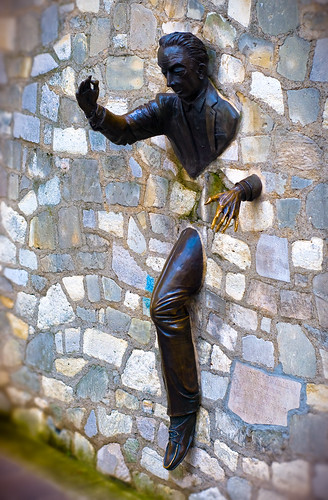
Le Passe-Muraille - The Man Who Could Walk Through Walls - Montmartre, Paris
Two sermons for the price of 1! Both preached on the same day, from the same notes, but it's interesting to me that they're quite different.
Preached at Trinity United Reform Church, Camden Town, on Sunday 11th April 2010, Second Sunday of Easter.
Preached at MCC North London, Camden Town, on Sunday 11th April 2010, Second Sunday of Easter.
John 20:19-31
When it was evening on that day, the first day of the week, and the doors of the house where the disciples had met were locked for fear of the Jews, Jesus came and stood among them and said, "Peace be with you."
After he said this, he showed them his hands and his side. Then the disciples rejoiced when they saw the Lord. Jesus said to them again, "Peace be with you. As the Father has sent me, so I send you."
When he had said this, he breathed on them and said to them, "Receive the Holy Spirit. If you forgive the sins of any, they are forgiven them; if you retain the sins of any, they are retained."
But Thomas (who was called the Twin), one of the twelve, was not with them when Jesus came. So the other disciples told him, "We have seen the Lord." But he said to them, "Unless I see the mark of the nails in his hands, and put my finger in the mark of the nails and my hand in his side, I will not believe."
A week later his disciples were again in the house, and Thomas was with them. Although the doors were shut, Jesus came and stood among them and said, "Peace be with you." Then he said to Thomas, "Put your finger here and see my hands. Reach out your hand and put it in my side. Do not doubt but believe." Thomas answered him, "My Lord and my God!"
Jesus said to him, "Have you believed because you have seen me? Blessed are those who have not seen and yet have come to believe."
Now Jesus did many other signs in the presence of his disciples, which are not written in this book. But these are written so that you may come to believe that Jesus is the Messiah, the Son of God, and that through believing you may have life in his name.
Acts 5:27-32
When they had brought them, they had them stand before the council. The high priest questioned them, saying, "We gave you strict orders not to teach in this name, yet here you have filled Jerusalem with your teaching and you are determined to bring this man's blood on us."
But Peter and the apostles answered, "We must obey God rather than any human authority. The God of our ancestors raised up Jesus, whom you had killed by hanging him on a tree. God exalted him at his right hand as Leader and Savior that he might give repentance to Israel and forgiveness of sins. And we are witnesses to these things, and so is the Holy Spirit whom God has given to those who obey him."
Originally published as a reflection in the MCC North London newsletter, 25th March 2010
As he was now approaching the path down from the Mount of Olives, the whole multitude of the disciples began to praise God joyfully with a loud voice for all the deeds of power that they had seen, saying, "Blessed is the king who comes in the name of the Lord! Peace in heaven, and glory in the highest heaven! - Luke 19:37-38
Throughout Lent we have been looking at what it means to follow Jesus and asking, what are we prepared to do for him? This week, as we head into Palm Sunday and Holy Week, we have the opportunity to follow Jesus in triumph in his final entry into Jerusalem.
This was the pinnacle of Jesus' ministry, the paradoxical moment at which his followers were rejoicing in his arrival and he was beginning to prepare for his betrayal and violent departure. To follow him at this moment, to be walking with him as his followers were spreading their cloaks out for him in the road, waving palms, shouting and praising God, must have been the most incredible privilege. For a group of poor men from small towns outside Jerusalem to be greeted like that in the holy city itself, I can't imagine how that must have felt.
It would have been a moment when it was easy to follow Jesus, when there was reflected glory to bathe in, when the disciples felt like the most important men in the world. All Jesus' followers in the city - men, women and children, from all social classes - at that moment really committed to Jesus. They were a strong group with faith; strong enough to put the wind up the Pharisees.
And so it was the turning point in the Pharisees' attitude to Jesus. They realised that he had a strong and loyal band of followers; they were scared that he threatened their monopoly on religious teaching in the city, they were scared of losing their power and influence in Jewish society. This was the moment when a group of Pharisees decided it was time to approach Herod and Pilate and tell them that Jesus was leading a band of rebels, that he threatened the stability of Roman rule in Palestine and that their only option was to arrest him as a dangerous revolutionary.
There is no doubt in my mind that the Pharisees really believed that Jesus was dangerous, and I know his teachings were revolutionary. We are blessed that they did not succeed in stifling Jesus' message, nor in halting the spread of his name across the empire, but for a time it must have looked like they had succeeded.
In one short week, Jesus went from entering Jerusalem in triumph to being arrested, sentenced and publicly executed. In one short week, the followers who were so committed to him on Sunday had disappeared by Friday. They were prepared to follow him in times of joy, but were too scared to stand beside him and share the burden of his punishment. Judas betrayed him, Peter denied him, many more withdrew and pretended he had never been their leader. People felt let down, they couldn't see past the arrest and execution to realise that Jesus was still the Messiah and their saviour. Jesus knew this, and knew that he was alone on his final walk that Friday, There were people following, and mourning, but they no longer felt like his disciples - his pupils - they were weeping for their loss, for their mistaken faith in a man who was fallible. 'Jesus turned and said to them, "Daughters of Jerusalem, do not weep for me; weep for yourselves and for your children."' (Luke 30:28), he was reminding them that it was not his frailty that had led to this moment, but humanity's dark and selfish heart.
I wonder how many people truly heard that message? I believe Simon of Cyrene understood, when he carried the cross for Jesus. I believe that the women who stood at the foot of the cross understood. Eventually, I know that the disciples came to understand, but they had to see the resurrected Christ first.
So when we get into Palm Sunday, remember that Jesus had this wonderful moment of triumph and glory. Remember that it is wonderful to follow Jesus when life is going well. But also take some time to think about what it means to follow Jesus when times are hard. Could we take up his cross? Could we still have faith as we watched him die? I pray that I could, and I pray that I will find the strength in times of darkness in my own life to have the strength of Simon and Mary, a faith that doesn't weaken when this world is cruel and cold.
Originally published as a reflection in the MCC North London newsletter, 4th March 2010. The Lenten reflections were on the theme of the hymn Will You Come and Follow Me?
Will you let the blinded see if I but call your name?
Will you set the prisoners free and never be the same?
Will you kiss the leper clean and do such as this unseen,
and admit to what I mean in you and you in me?
Sometimes I think that the responsibility given to us as Christians is almost impossible to fulfil. Jesus said, “A new command I give you: Love one another. As I have loved you, so you must love one another.” (John 13:34) That doesn’t sound so bad until you start to look at it in detail and really think about what is being said. What does he mean when he says, “as I have loved you”?
Jesus’ life and ministry was completely rooted in love. Everything he did was for the love of humanity, from enduring tests in the wilderness from Satan until the day he died in agony on the cross. The seasons of Lent and Easter are all about the raw emotion that is at the heart of our faith; love.
Jesus showed that love in many different ways, some of which are easy to follow and some of which are almost impossible for us. He spent time with the people at the lowest end of the social scale; sinners, tax collectors, women, fishermen, people who were ill or disabled, and the list goes on. He broke bread with them, he taught them the will of God and he tended to their needs. Would we dare to look after those we consider beneath us, no matter what the cost? Would we wash the feet of anyone we don’t know, let alone those we don’t like? Would we kiss a person with a deforming and debilitating highly-contagious skin condition?
Jesus healed in the name of God. He resurrected Lazarus, healed all sorts of disabilities and debilitating illnesses. He continued to travel around healing those he loved, even when he knew that Herod was looking for him, and that he was soon to be arrested and executed. Would we have the faith to heal someone in the name of God? Would we have the strength of will to carry on doing this if it would cost us our lives?
And if we did do all these things, if we fulfilled the commandment to love one another and truly showed the love of Christ to all our neighbours, would that be enough? No. Jesus says that not only should we do these things, but we should do them unseen, out of no desire but to please God. We should not seek the recognition of people, or the thanks of the healed. There should be no reward for this work but the knowledge that it is the work of God we are doing. The only thing we should be seen to proclaim loudly and without fear in the face of the public is the love of Jesus Christ. We should admit what he means to us all day, every day. We should not be too embarrassed to tell our non-Christian friends we’ll pray for them, nor too ashamed to admit we go to church. We have to come out as Christians, even if we are persecuted. And if we lose everything, even our lives, we will have lost nothing as long as we have loved the world and our God, and lived that love in every aspect of our lives.
Published in MCC North London's newsletter, 9th December 2009.
But the basic reality of God is plain enough. Open your eyes and there it is! By taking a long and thoughtful look at what God has created, people have always been able to see what their eyes as such can't see: eternal power, for instance, and the mystery of God's divine being. Romans 1:20-22, The Message
Have you ever seen God in something unexpected? Have you ever exchanged a smile with a stranger in the street and felt as though you forged an indestructible friendship?
I was struck the other day by all the incredible, diverse, wonderful things in creation that point us to God. Whether it’s the smile of a child on the bus, or the way that the sunlight shines through the trees onto the buildings you see every day. Sometimes it is the small reminders that make us remember who God is and what God does for us.
When that happens, it is right to give thanks and praise to God. It’s the time we should take a deep breath and say in our hearts what a faithful, awesome God we have. Those moments can be lifesaving, they are sent to us to remind us that we are blessed and loved. That the awesome God who created the universe is also watching over our daily lives. I don’t think I will ever be able to get my head around that and I love that beautiful mystery.
In this advent season, we are looking forward to the clearest manifestation of God’s love; the anniversary of the birth of the Son of God – Emmanuel, God with us, the Messiah – we must also be attuned to the miracle of daily life. Give thanks to God; God’s love endures forever!
The church Christmas party was this evening and I had so much fun throwing wrapping paper (from Pass the Parcel, of course!) around the room, and singing dodgy karaoke songs with The Wife. It was brilliant, and we had a lovely drink in the pub around the corner afterwards (one of my favourites, although at least one of the guys I was with was miffed that I took him to a straight pub!), and just had a lovely evening.
Work tomorrow, and then the Second Sunday of Advent service. I'm looking forward to it; I'll be celebrating communion.
As Delores Berry would say, tonight we had church!
There was so much power in the worship, people were really letting go and singing like they meant it. The worship leader spoke powerfully on her transformative experiences in the last few months, the intern who preached gave a wonderful message on Christ the King, and the crown of forgiveness Christ empowers us to wear. I felt, for the first time celebrating communion, able to fully understand what a blessing it is to be allowed to serve the congregation in that way. I left feeling elated. There was a joy and peace in my heart that reminded me what it is to know the grace and love of Christ.
Preached at MCC North London on Sunday, 13th September 2009.
James 3:1-12
Not many of you should become teachers, my brothers and sisters, for you know that we who teach will be judged with greater strictness.
For all of us make many mistakes. Anyone who makes no mistakes in speaking is perfect, able to keep the whole body in check with a bridle.
If we put bits into the mouths of horses to make them obey us, we guide their whole bodies.
Or look at ships: though they are so large that it takes strong winds to drive them, yet they are guided by a very small rudder wherever the will of the pilot directs.
So also the tongue is a small member, yet it boasts of great exploits. How great a forest is set ablaze by a small fire!
And the tongue is a fire. The tongue is placed among our members as a world of iniquity; it stains the whole body, sets on fire the cycle of nature, and is itself set on fire by hell.
For every species of beast and bird, of reptile and sea creature, can be tamed and has been tamed by the human species, but no one can tame the tongue--a restless evil, full of deadly poison.
With it we bless our God and Parent, and with it we curse those who are made in the likeness of God.
From the same mouth come blessing and cursing. My brothers and sisters, this ought not to be so.
Does a spring pour forth from the same opening both fresh and brackish water?
Can a fig tree, my brothers and sisters, yield olives, or a grapevine figs? No more can salt water yield fresh.
Mark 8:27-38
Jesus went on with his disciples to the villages of Caesarea Philippi; and on the way he asked his disciples, "Who do people say that I am?"
And they answered him, "John the Baptist; and others, Elijah; and still others, one of the prophets."
He asked them, "But who do you say that I am?" Peter answered him, "You are the Messiah."
And he sternly ordered them not to tell anyone about him.
Then he began to teach them that the Son of Man must undergo great suffering, and be rejected by the elders, the chief priests, and the scribes, and be killed, and after three days rise again.
He said all this quite openly. And Peter took him aside and began to rebuke him.
But turning and looking at his disciples, he rebuked Peter and said, "Get behind me, Satan! For you are setting your mind not on divine things but on human things."
He called the crowd with his disciples, and said to them, "If any want to become my followers, let them deny themselves and take up their cross and follow me.
For those who want to save their life will lose it, and those who lose their life for my sake, and for the sake of the gospel, will save it.
For what will it profit them to gain the whole world and forfeit their life?
Indeed, what can they give in return for their life?
Those who are ashamed of me and of my words in this adulterous and sinful generation, of them the Son of Man will also be ashamed when he comes in the glory of his Father with the holy angels."
***
I want to start by looking at the reading from James this week, particularly the opening sentence. James says this; “Not many of you should become teachers, my brothers and sisters, for you know that we who teach will be judged with greater strictness.” Fantastic. I’m sure the other preachers, clergy, PGCE students and NQTs in the room squirmed just as I did when I read that. I really had to think long and hard about it; what is this reading saying to me right now? What should I be thinking about in my relationship with God right now? Who should teach, and what gives us that authority?
In MCC, we believe that everyone is called to minister, and I do believe that wholeheartedly. I’ve preached before about the fact that whenever we do anything outside ourselves that is Christ-centred and others-centred, we are ministering. That could be helping someone cross the street or giving a friend a hand moving house, or you may do it day-to-day in your workplace. But we all do it differently. We are all made in the image of God but none of us can *be* God. We have different aspects to our personalities that reflect God’s glory and when we stand together as a church – ekklesia, assembly – we reflect a full range of talents. But I would like to respectfully correct the writer of James. Scholars think that James was from the Jewish teaching classes, and would have been eligible to become a teacher by virtue of his background and education. So his anthropology is very much that not everyone is called to be a teacher. He was also expressing concern at the sheer range and diversity of teachings and teachers around in the early church, which was a time of controversy and theological uncertainty. So I would just break his comments down a little further and say that not everyone is called to teach as a vocation. I do believe that each of us is empowered and called out to teach at different times in our lives, as group leaders, as parents and siblings and as friends.
But the challenge is to know when to teach, and what to say. To speak on the word of God is a tremendous privilege which we have all been granted, but it is not to be taken lightly. I find that I get asked about my faith a lot, particularly in the LGBT community. And those questions are not flippant, or unimportant. How we express our faith and how we talk about our faith is the very real way in which we introduce Christ to other people and that is not an easy thing to do. If we are disingenuous or ashamed of what we are saying, if we are conscious that it is not very cool at the moment to be Christian or scared that we are addressing someone who has a problem with faith, it’s too easy to stumble, oversimplify, or to try to adapt our faith to suit what they want to hear; we dilute the message to get people to listen to us or to come to our church and that is dangerous. We are judged harshly on how we teach because it shows what we think of God.
And Jesus won’t stand for false teaching, not from anyone. His dialogue with Peter in Mark is a fascinating example of this. Peter has come to recognise that Jesus is more than “another prophet”. Peter has come to the realisation that Jesus is the Messiah – the anointed one of God come to deliver the Jewish people – and rather than praising him for his insight, Jesus asks them to tell no one. He recognises that Peter does not yet have the insight to share this news, and that his understanding of Jesus’ nature will not be well-received by the majority whom he is teaching. Rather than allow misinformation to go out, Jesus asks him to keep quiet. In a few verses time we see why. Although Peter has understood that Jesus is the Messiah, he has not understood the full reality of that. Faced with the possibility of Jesus being put to death, Peter is scared. He doesn’t want to hear it so he tries to get Jesus to change his tune, not to talk about it. We don’t know what he said, or what his motivation was, but he was contradicting God. He was trying to say that he knew better. And in four words, Jesus knocks him back, “Get behind me, Satan!”. Peter confesses the messiah on one hand and then speaks false teaching on the other.
When we come to church, we confess Jesus as Messiah, as God and Lord. We sing hymns and praises in His name and we ask for intercession for those we love in His name. We say that to see the face of God we need to love one another, and we confess the times we have sinned against each other. We recognise Jesus in each other. We are like Peter at the moment of revelation, filled with knowledge of the nature of Jesus and the reality of the sacrifice of God in Christ. It is joyful and wonderful, and the last thing on our mind is to be ashamed of Christ, of the words of the Bible or of our faith. But something changes when we walk out of these doors. We almost immediately start to speak differently, we view each other differently. The same tongues we used to praise God’s name and to speak holy truths we use to speak ill of each other, to enter into games of one-upmanship and to gossip. We don’t see Christ in each other any more, we complain about the flaws in other people that we ourselves possess because they are what make us human. We presume to judge other people’s sins when we have not had the grace to recognise and fully confess our own.
And let’s be honest about the word sin, and the idea of sin. We are blessed, sitting here, because many of us have only been able to come to this place through years of prayer, reflection and theological study. We have examined the Bible and the claims of others critically as they concern human sexuality and come to the glorious revelation that a sexual identity – and the act of living it out, whatever it may be – is not sinful. It’s a “messiah” moment. A moment of pure, wonderful realisation. But do we, like Peter, sometimes take that revelation too far? Just as Peter thought that his understanding of Jesus’ nature meant that Christ wouldn’t have to die, do we sometimes think that because we are not judged and condemned on our sexual orientation that we don’t need to think about sin? But it is still present in our lives, it is a fact of our humanity and free will. Sin separates us from the love of God; it is anything that we do to ourselves or to other people that is for our own glory or our own fulfilment at the expense of expressing the love of Jesus. We sin against ourselves and God when we undervalue our lives, talents and deny God’s call. We sin against others – who are all made in the image of God – when we ignore them, speak badly of them or deliberately provoke conflict with other people. Even the times when we don’t do it consciously, when we, like Peter, think we are doing the right thing.
We come together every week before Communion to confess our sins to God, but do we ever truly think about the impact of what has happened in our lives in the week? Do we even acknowledge most of the sins we commit on a daily basis? When we laugh at someone to fit in, or tell a joke that alienates people, or refuse the chance to share the love of Jesus with someone else we have sinned against God. When we hear a call on our lives and we ignore it, for whatever reason, we have sinned against God. And when we sin against God by devaluing other people or by underselling our faith in Jesus we are harming our relationship with God and we are putting a stumbling block in the way of someone else’s faith. We are separating not only ourselves, but also another person whose faith and salvation should be as dear to us as our own, from the love of God and that is inexcusable. When we speak the words of God and confess our faith with our mouths but our actions reveal that our hearts and minds reject God’s law, we misrepresent Christ into the world. We become as Satan to them, that is, as the one who denies the words and works of God.
We were made in the glory of God but we do all tend towards what Paul calls the sinful nature. We can acknowledge this, but we need not – indeed, we should not – embrace it. Instead we need to take time and use our God-given spirit of discernment to understand from where our actions are coming. Are they of the world, are they from a desire to conform and to fit in? If they are, they are not from God. Christians can’t live our lives fitting in. We are not called to fit in; we are called to stand out. It’s a glorious calling but it isn’t easy. It is not a new thing, or a modern thing, for Christians to be rejected by our peers. We have always been seen as ignorant, or misguided, Richard Dawkins is hardly the first! These days it is popular to assume that Christians are incapable of rational thought, that we cannot be intelligent or show empathy to others. It takes great strength to stand up for God and for the gospel, and to recognise when we sin. It takes soul-searching and a deep dependence on the power of the Holy Spirit living within us. Then we can go out and shout the gospel of Jesus, and share the love, peace and grace of Christ. Then we can go out and live the gospel, and show the way of Christ. Then we can bring Christ to the world that doesn’t know him. Just as a badly-placed word can start a fire of unbelief and rejection, the right word can quench the fire and bring salvation to a world that needs the tangible love of Christ.
You are blessed people, go and shout forth the blessing into the world. Do not be ashamed of the gospel, but speak the truth of Jesus and praise Him to all the world. When you are called to speak, or to teach, do so in a spirit of discernment, not for your glory but for the glory of God. Confess your sins faithfully, and ask for the forgiveness that God wants to hand down. If there is something you are holding on to, that you feel is so bad you don’t think God will forgive you, let it go. Bring it to God tonight and start afresh. If you confess and accept the forgiveness freely given, you are free to go into the world and be not ashamed, be ashamed neither of yourself nor of the gospel of Christ; go into the streets and praise Him!
I was lucky enough to visit the Greenbelt festival this weekend with a number of other members of the church. It was my first festival experience (and only second Christian holiday, the other was whilst I was still at school) and I was a little bit wary. I think I expected factional infighting, guilt-inducing discussions and sermons and lots of socks and sandals! I was looking forward to it, but with some nerves.
So it was a relief to arrive on Friday night and realise that I didn’t stand out like a complete freak, the talks and worship planned looked fantastic and there were loads of craft stalls to look at longingly! From Sixpence None the Richer on Friday to Athlete on Monday via talks by Bishop Gene Robinson, Sami Awad and worship from Tim Hughes to Taizé it was a complete whirlwind of a weekend. But the most important lesson I learned from the weekend didn’t come from a single talk, worship set or performance. Instead, it was an unspoken theme of the time I spent at Cheltenham.
Fractures in the church come from all sorts of places, and are nothing new. From the early councils (Nicea in 325 was convened to combat the heresy of Arianism) to the creation of Gafcon (the Global Anglican Future Conference / Federation of Confessing Anglicans) in the wake of Gene Robinson’s consecration as the openly gay Bishop of New Hampshire. These factions and splits cause nothing but pain and heartache. Even when the grievances are genuine and deeply felt, both sides are hurt. Following Christ authentically means that we have to make sacrifices, but when doing this is causing pain to others as well as forcing us into sacrifices, is it authentic? It is Christ-like to build your own opinions and theology up to such an extent that others are destroyed?
By contrast, when we work together in faith amazing things happen. Conflict is part of life, and it is human nature to want life to be fair. We see what others have, how they are treated, and we want that. But life isn’t fair, and being Christian or spending time with Christians doesn’t change that. Church isn’t perfect, because we aren’t perfect. But we can learn to do the right thing. We need each other, we need to be in unity with other. It is important that we safeguard our own needs by asking for help when we need it and taking the support we are offered, and it is equally important that we offer help and support to other people in pain and not to turn your back on people or communities that need you. You don’t get back what you put in; life isn’t like that. You do get back what you need, by the grace of God and in the love of your community.
Preached at Trinity URC and MCC North London, both Camden Town, on Sunday 16th August 2009.
Ephesians 5:15-20
Be careful then how you live, not as unwise people but as wise, making the most of the time, because the days are evil.
So do not be foolish, but understand what the will of the Lord is.
Do not get drunk with wine, for that is debauchery; but be filled with the Spirit,as you sing psalms and hymns and spiritual songs among yourselves, singing and making melody to the Lord in your hearts giving thanks to God the Father at all times and for everything in the name of our Lord Jesus Christ.
John 6:51-58
"I am the living bread that came down from heaven. Whoever eats of this bread will live forever; and the bread that I will give for the life of the world is my flesh."
The Jews then disputed among themselves, saying, "How can this man give us his flesh to eat?" So Jesus said to them, "Very truly, I tell you, unless you eat the flesh of the Son of Man and drink his blood, you have no life in you. Those who eat my flesh and drink my blood have eternal life, and I will raise them up on the last day; for my flesh is true food and my blood is true drink. Those who eat my flesh and drink my blood abide in me, and I in them. Just as the living Parent sent me, and I live because of the Parent, so whoever eats me will live because of me. This is the bread that came down from heaven, not like that which your ancestors ate, and they died. But the one who eats this bread will live forever."
***
I have a small confession to make. It’s taken me a long time to learn to love the Bible. I grew up in a non-Christian household for most of my life (although we went to church when I was small, and I have never forgotten the most important lesson of Sunday School – how to make a palm tree out of a piece of old newspaper!), and became a Christian at the grand old age of fifteen.
Eight years later, I still sometimes wonder if I’ve quite got the hang of this Christianity malarkey. I’m sorry if that’s not what you want to hear from a preacher so bear with me and I’ll try to make up for it! The thing is; I’m not always that keen on the Bible. I spent a lot of time having pretty negative encounters with Scripture. To paraphrase the fabulous Kit and the Widow, I was convinced that Leviticus was just written a bigot having a bit of a rant. I dismissed all of the writings of St. Paul, thinking that they fell into a broadly similar category. A lot of the Bible didn’t seem to agree with my view of, and experience of, God. So many of the rules seemed irrelevant – I don’t know anyone who seriously has concerns about wearing wool-linen mix, and it’s been a while since I saw anyone attempt to stone an adulterer or buy a slave. It seemed as though there was too much time given over to long lists of don’ts, discussions of out-moded gender models and contradiction.
And it seems that this is a lot of people’s view of the Bible. I recently read a fantastic memoir by a man named A.J. Jacobs. He is agnostic but was brought up in a Jewish household, decided to spend a year living “Biblically”. That is that he attempted to follow every commandment laid out in the Bible, beginning with the 613 mitzvot, or commandments, that are found in the Old Testament. He invited an orthodox man into his home to analyse the fibre content of all his clothing – apparently it’s only mixing wool and linen that’s forbidden, by the way – wore a white tunic, grew a beard so unruly that people avoided him in the street and painted scripture on his door frame. (Incidentally, there’s a picture here showing him on the last day of the project.) He even had his sons circumcised and approached an adulterer in Central Park to gently throw a couple of pebbles at him. All in the name of research. The response to his project from other people was fascinating. The beard and while robes – not to mention the wooden staff from eBay – made him look more religious. People avoided him on the subway, and every waking moment was spent wondering if he had accidentally broken any rules in the last five minutes. He spent so much time following rules it begins to look like he has no time to live. I’ll come back to him later.
Take tonight’s reading from Ephesians; it just reads as a telling-off, the author sounds like a kill-joy, something of a puritan. Don’t drink, don’t be stupid, don’t act up, don’t make a fool of yourself. It reads like one of the tedious etiquette guides from the last century that are endlessly reprinted as novelty gifts. It stands in sharp contract to tonight’s gospel reading. In Jesus’ teaching, there is nothing that sounds like traditional Jewish law. Nothing, in fact, that sounds like any contemporary law. Jesus’ world, an area of the middle east that is now, broadly, Jerusalem, the West Bank of Israel and Palestine, was ruled over by the Roman empire, under the jurisdiction of King Herod and the local Roman governor. Cultures converged on Jerusalem, Latin and Aramaic were spoken equally, and the learned were literate in Greek. But no religion, no philosophy, could ever prepare those present to hear what Jesus had to say. Listen to the words of Jesus again, imagine hearing this for the first time.
“I am the living bread that came down from heaven. Whoever eats of this bread will live forever. This bread is my flesh, which I will give for the life of the world…
Very truly I tell you, unless you eat the flesh of the Son of Man and drink his blood, you have no life in you. Whoever eats my flesh and drinks my blood has eternal life, and I will raise them up at the last day. For my flesh is real food and my blood is real drink. Whoever eats my flesh and drinks my blood remains in me, and I in them. Just as the living Father sent me and I live because of the Father, so the one who feeds on me will live because of me. This is the bread that came down from heaven. Your ancestors ate manna and died, but whoever feeds on this bread will live forever.”
It’s just surreal. Firstly, there is someone who is very clearly flesh and blood claiming to be “living bread”. What does that mean? He also claims to be the Son of God, so who is God? Have we unknowingly eaten God every time we munch on a sandwich? Was the heavenly manna actually the flesh of God? More to the point, is he asking us to eat him? And drinking his blood? There must be a law against that – is Jesus kosher? Does he have self-renewing flesh or something? This is science-fiction stuff, really, the stuff of nightmares.
And if that’s what was perplexing those present who accepted Jesus’ divinity, what on earth must the people around have been thinking if they didn’t believe Jesus was the Son of God. It is almost impossible to understand this from a modern perspective, but even today there are scores of polemical essays claiming that Christians validate cannibalism by the very act of Communion. But that’s not what’s going on here. Jesus in John’s gospel spends a lot of time discussing His nature and pointing to His death and the arrival of the Holy Spirit. This discussion is a clear precursor to the first communion at the Last Supper, the following Passover. It also begins to point to the idea that we call the trinity, Jesus is talking about taking in an aspect of God as today we call upon and take in the Holy Spirit.
So, to contrast the two texts again, we have two contrasting images of Christianity. The first is a traditional, almost puritanical view. The emphasis is on law, the laws of Moses in Leviticus, the book of Deuteronomy (Greek – the second law), the laws cited by St. Paul and by Jesus himself. But that is a very one-dimensional view of Christianity. If I could return for a moment to A.J. Jacobs and his tremendous beard, he set out only to follow the law. He was interested in the motivations of those who followed the laws, and unsure whether he would feel any spiritual connection. He was particularly challenged by the commandment to “love the Lord, Your God”. Loving your neighbour, yes, he could do that. Have no other gods, well, yes, being agnostic is helpful there. Not making graven images was a challenge on family holidays with his wife and a camera but on the whole it was fine. Until he discovered the commandment that makes the Bible more than just another rule book. The Bible points us to a connection to the divine; it leads us to Christ, to God and the Holy Spirit. Law is not distinct from a connection to God. It is an important part of our connection to God. Jesus, who brought the spirit, also re-affirmed the law. In the opening of John’s gospel, in the very first verse, Jesus is referred to as the logos, which is a wonderfully ambiguous Greek word. It means word, meaning and has even been translated as law (although we don’t ever see it used as a term for secular law).
The joy of this passage in John, for me, is the connection between the spirit, the law / text of the Bible, and the body. Like the Law, the body is often separated from the spirit. Since the middle ages, we have been taught that the tangible, the ‘real world’ is base and ugly and distinct from the glorious realm of God. St Paul, in one of his other letters, complains that his body doesn’t do as his spirit wants to, that he is unable to live up to the way he wants to live. It is one of the perils of being human that we can’t live up to who we want to be, and being Christian doesn’t change that. We are used to associating the body with the Law, not the spirit. The desires of the body are associated with sinfulness, from overeating to sexual immorality. And the world confirms this. A glance at a television or at a magazine cover will tell you that your body is all wrong. That you aren’t eating the right things, aren’t exercising properly, aren’t the right shape for this season’s fashions. The body has become associated in the secular world with guilt and shame.
But we know that we are made in the image of God (Ps. 139 – “I praise you for I am fearfully and wonderfully made). Of all God’s creations, humans were made in the image of God. Everything about us is sacred and cared for. This gospel passage follows on directly from John’s telling of the feeding of the crowds – it is so important to be fed by the Word of God, but Jesus cares for our physical wellbeing and nourishes those present in a clear nod towards what was to come. Jesus also alludes to the Exodus, when the Jewish people were isolated in the desert, between Egypt and their promised land. During this time of isolation, when they were wandering in exile because they had turned against God, their bodies were still cared for when God sent manna from heaven. Not just a little bit of dry bread and water that would sustain them, but the most wonderful, sweet manna that tasted of honey and enough every 6th day to give us a feast. That’s not a God that sees out bodies as vehicles, or our earthly life as a base precursor for a glorious afterlife. That’s not a God that views desire and pleasure as sinful.
So the call to feed on Jesus’ body is fulfilling both a spiritual need and a physical one. In Communion, there is a spiritual experience that connects us to Jesus and also instantly to Christians throughout history and to the Jewish commemoration of the Exodus. The word Eucharist is from a Greek root and translates as “thanksgiving”. In taking the Eucharist we are giving thanks for the life of Christ, as well as reaffirming out commitment to giving our lives and spirits to Christ in the here and now. Communion is a time to take stock of our lives and a reminder that we have a shared humanity with each other and with Jesus. It is a reminder that our lives and our bodies belong to Christ, and that God is the one who protects and feeds our souls and our bodies. Jesus, the logos, fulfils the law, embodies human perfection and leads us to be one in the name of God who sustains us. So when you come to take Communion, stop and think about what you are doing. This is not an empty ritual, but the very embodiment of the Christian faith and a reminder of God’s love which is given lavishly to each of us.
A lot of us were at Brighton Pride on Saturday, enjoying the rain and the carnival atmosphere. People like me, who had never been before, were marvelling at how open everything was, how people marched with their families and the whole town seemed to turn out. There was no visible counter-protest and it was incredibly liberating to be a part of something like that.
But then, when I came home, it was like a rude awakening. I turned my laptop on and saw the following: Two killed in shooting at Tel Aviv gay centre. It seemed unreal.
I flew to Tel Aviv in December, and spent 6 days travelling around Israel. I was struck by the atmosphere of Tel Aviv. Whereas Jerusalem was defined by boundaries and quarters, where you could tell the culture of an area by the language displayed on the buses travelling there, Tel Aviv felt more like a part of London. Languages mixed in the street, menus reflected cultures converging, and there is evidence of a small, but busy, gay scene. My friends who live and spend time in Israel talk about Tel Aviv as a haven for LGBT people who have suffered discrimination in the more religious areas of the country, and it felt like that to me as a visitor.
I was encouraged that by the time I found out, only a few hours after the shooting occurred, there were already people gathering to hold vigil outside the centre in memory of 26-year-old Nir Katz and 16-year-old Liz Tarboushi, and the 13 others who were injured. The man dressed in black, wearing a mask and carrying a gun, who inflicted all this terror on the community, seems to have acted alone in an act of violence. The community who were devastated, however, stood as one body of many parts amidst this violence to pray for peace and bless the memories of those they have lost.
And it is the image of the Israeli LGBT community and their allies standing together in peace that gives me hope. The responses of Israeli politicians, who unanimously condemn the shootings as hate crime, remind us that society is moving on. Individuals may hold on to their hate, and this can devastate us, but we have solidarity and we have our allies. Most of all, we have the strength of the God of Israel and of Jesus Christ, who called Israel His home. We pray for peace in Israel, for reconciliation of communities of different religious and cultural affiliations and for strength for the young people of Israel to be who they are and to continue to stand as one against hate in all its forms.
Preached at Trinity URC and MCC North London, both in Camden Town, 21st June 2009
Job 38:1-11
Then the LORD answered Job out of the whirlwind:
"Who is this that darkens counsel by words without knowledge?
Gird up your loins like a man, I will question you, and you shall declare to me.
"Where were you when I laid the foundation of the earth? Tell me, if you have understanding. Who determined its measurements--surely you know! Or who stretched the line upon it? On what were its bases sunk, or who laid its cornerstone when the morning stars sang together and all the heavenly beings shouted for joy?
"Or who shut in the sea with doors when it burst out from the womb?-- when I made the clouds its garment, and thick darkness its swaddling band, and prescribed bounds for it, and set bars and doors, and said, 'Thus far shall you come, and no farther, and here shall your proud waves be stopped'?"
Mark 4:35-41
On that day, when evening had come, he said to them, "Let us go across to the other side." And leaving the crowd behind, they took him with them in the boat, just as he was. Other boats were with him. A great windstorm arose, and the waves beat into the boat, so that the boat was already being swamped. But he was in the stern, asleep on the cushion; and they woke him up and said to him, "Teacher, do you not care that we are perishing?" He woke up and rebuked the wind, and said to the sea, "Peace! Be still!" Then the wind ceased, and there was a dead calm. He said to them, "Why are you afraid? Have you still no faith?" And they were filled with great awe and said to one another, "Who then is this, that even the wind and the sea obey him?"
***
It’s been an eventful couple of weeks, I bring greetings from MCC Austin, TX, the Office of Formation and Leadership development, 19 MCC churches represented at REVM and of course MCCBE, Clinton Crawshaw and Leon Huton. It always does me good to visit churches in our communion and see just what MCC is capable of; what strength, joy, faith and fellowship we can share with one another.
These few verses in Mark have all the tension and drama of a major Hollywood blockbuster condensed into a few short verses. We see Jesus, the big-time celebrity, climbing into his chauffeur-driven vehicle to escape the crowds (well, it’s a fishing boat, but bear with me). Then, horror of horrors, a crisis begins. The storm clouds gather, the others in the boat begin to look worried. We know they are experienced sailors, fishermen even. They know these waters; their livelihoods depend on their ability to successfully cross a lake in any conditions, but they are clearly worried. Rain is pelting down from all sides, they are caught in the most terrible winds, and they can see waves crashing down on all sides. The tension builds as the little wooden fishing boat containing out hero and his underdog companions is thrown across the waters. It is dark, we can barely make them out, and the soundtrack is full of dramatic chords in the strings and violent percussion. The audience is on the edge of their seats, but something is wrong. In the middle of all that violence, and drama and chaos, we realise we haven’t seen Jesus for a while. Where is he? Has he fallen out unnoticed? What is going on? Then one of the disciples moves to the front of the boat. Jesus is lying, motionless. Surely something has happened to him? How could he fail to be woken up by all the commotion? One of the disciples – we don’t know who but I think the smart money is on Peter – wakes him, desperate for some help. “Master,” he says, “do you not care that we are perishing?” Jesus’ response is puzzling. He is little more than irritated at the response. In something of an anticlimax, we get a small gesture, a word of peace and a rebuke (“Have you still no faith?”) and the water is calm.
So, Hollywood would be disappointed. Imagine the re-write if that was how The Perfect Storm, Titanic or the Poseidon Adventure had been drafted! You see the director, wince “well, it’s good, Mark, but it’s lacking that punch. You ruin the tension, it’s over too quickly. Can’t you kill off a minor character in the early parts of the storm? One of those saints no one knows the name of, or one of the brothers, just to build up the tension? Then give Jesus some doubt. Some really scary doubt, like he doesn’t know if he can do it and then all of a sudden – BAM! Do you see what I’m saying?”
Thankfully, God doesn’t write Hollywood disaster movies. No one died, because Jesus was with them, and the hand of God was on their voyage. When they set out, they should have know that whatever happened they would be safe. They should have known when the storm started that they could rely on God to get them to the other side. And to an extent they did, but they are only human. Just like the rest of us, they eventually panicked and woke Jesus up. They knew God would keep them safe, but seeing Jesus asleep made them doubt. They thought that they would not be saved unless he woke up and perform a miracle. Jesus knew that this was why they woke him up, and I wonder, to whom did he say, “Peace! Be calm!” According to Mark, it was directed at the sea, but he didn’t need to speak to the see. He could silence the sea by lifting a finger, winking an eye, or just willing it silently. Jesus always speaks as he performs his miracles, and I think that’s because He is speaking words that the spectators need to hear. Speaking to the sea is not what calmed it, but I bet those words had an impact on the disciples. “Peace!” – stop panicking. Stop crying. “Be still!” Stop trying to control the boat. Stop trying to use your own power to keep you safe. God is in control.
Then, once they were calmed down, he asks the big question. “Have you still no faith?” After all they have seen Jesus do, after they left their homes and their livelihoods to follow him, have they still not enough faith to trust him with their lives? It sounds very familiar. Many of us in this room have chosen to lay down our lives and follow Jesus. We may have lost family, friends, even relationships and jobs, to follow Him. Or we may have been fortunate enough to lose nothing but the odd Sunday night, but we profess that we are ready to follow Him. We willingly give up our hearts and souls, we are ready to seek him and to give everything we have. But in my experience we all hold something back.
I am reminded of something that was said to me a few weeks ago by a much wiser person. David Mullatt, who was working with the Office of Formation and Leadership Devpt. on REVM, gave this advice; “It is much easier to be a pastor than to be a Christian”.
It is much easier to be a minister – and we are all ministers, in MCC we believe firmly in the priesthood of all believers – than it is to be a Christian. It is easy to find the words to say to someone when they are distressed, to pray with someone who needs it, than to calm our own spirit, to ask for prayer from someone else, and to spend time alone with God. But although we are called to demonstrate our faith in public it is by living it and not by big gestures and “look-at-me” Christianity. When we make it look like we are giving our all in public, what are we holding back in private?
I struggled for many years with depression. It still comes and goes, but for a long time after I became a Christian I held that depression back from God. I used to think that it represented a failure, and was something that had been given to me as a punishment for being gay. My church didn’t particularly do anything to dissuade me of that belief and it persisted. The longer it went on the more I held back from God. I would ask for prayer about it in public, but when I prayed on my own I persisted in neglecting it. There was a sort of pride in it, my depression was my Cross to Bear, and I let myself be so defined by it that I didn’t see a way that I could carry on living without it.
Eventually, I began to realise that it wasn’t necessary to hide behind an illness in order to be myself. I realised that people didn’t spend time with me because they felt sorry for me, but because they actually liked me. I began to realise that God wasn’t punishing me, and I started to let go. It was the most liberating thing that I have ever done. It was as though I heard God say to me, “Have you still no faith?” Do you think, after all I have done for you, that I can’t lift this burden? Do you honestly believe that just because I seem to be asleep on a cushion I am ignorant of your plight? Did I not tell you I would never leave you? Peace! Be still!”
In the first reading, we heard God say the same thing to Job. I don’t know about you, but I struggle reading the story of Job, so I’ll try to unpick it a little. Job is the central figure in one of the OT books known as the “wisdom books”. Like the Psalms, Proverbs and the Song of Songs, Job is full of allegory and discussion of the nature of God. The book opens with a discussion between God and Satan. I need to make one thing clear, here. Satan in the OT is not a little red man with a pointed tail and horns. He is, in Hebrew, called ha’ satan, which means The Accuser. At the beginning of the story, we hear that Job is an honest, God-fearing man who is good to his family and servants. However, as the narration goes on, Job loses everything. First his children, his servants and his property, and then his health. Throughout the whole ordeal, he continues not just to resign himself to God’s will but to give himself to God gladly and to praise God’s name. After a while, he starts getting visits from friends and from members of his community. Fine, upstanding people whom we would call pillars of the community come to offer comfort. God doesn’t get it wrong, they say. You must have sinned, or maybe your children did. Someone is being punished. Call on God to forgive you and make it right.
After a long time, what must have felt like a lifetime of agony to Job, God decides to answer his prayer. But the answer, as we heard tonight, sounds cryptic and critical to human ears. Listen to the opening of God’s response again; this time in translation from The Message;
Why do you confuse the issue? Why do you talk without knowing what you're talking about?
Pull yourself together! Up on your feet! Stand tall! I have some questions for you, and I want some straight answers. Where were you when I created the earth? Tell me, since you know so much! Who decided on its size? Certainly you'll know that! Who came up with the blueprints and measurements? How was its foundation poured, and who set the cornerstone, while the morning stars sang in chorus and all the angels shouted praise? And who took charge of the ocean when it gushed forth like a baby from the womb? That was me!
Can’t you hear what is being said to Job here? God says, “You might think this is important, but sweetheart this is nothing. I created you. I created the heavens and the earth. And you have no idea what your place in that is, do you? You don’t know how I did it or what you mean to me. That sounds to me an awful lot like what Jesus was saying to his disciples. “Peace! Be still! Have you still no faith?”
No one is denying that Job was fearful of his life. It was all he had left to lose. And the disciples were terrified, they genuinely believed that they were in mortal peril. But what, in reality, does that mean in the great scheme of God’s plan? If we profess with our hearts, minds and bodies that we will stand alongside God in Heaven forever – however you imagine and interpret that – then does it really matter if we lose our lives in this world? There is nothing wrong with being scared, but when that happens the important thing is to look back at God. If you think that all you can see is Jesus asleep, don’t think that means God is ignorant of your plight. Since Pentecost, we have one thing that the disciples didn’t yet have, and that Job could not have imagined. We have an advocate in the form of the Holy Spirit, who lives in us and guides us. Now it is we who can channel the power of God and say to the storm around us, whether it is a literal storm, an illness, a difficult relationship with friends, with Church or with a partner, “Peace! Be still! I have faith!” We can find it in us to get over anything we are faced with. We can also bless those around us with the peace that surpasses all understanding in Jesus Christ and help them to see that there is no storm in this life that is greater than the power of God.