I haven't done this for a while, so I thought I would link you to people who blog interesting things and are lovely.
Here's a few for starters (in no particular order);
Fashion Launderette is my cousin Milly's blog. Here she tells everyone in the world how she manages to look so fabulous so much of the time...
Miss Hilton Ink is Milly's equally fabulous and talented sister, who is a brilliant artist and works caring for young people with autism and other challenging behaviour. (I think the creative traits must be on the Hilton side, my sister picked them up but I didn't so much!)
NOLA Noodlings is the Big Easy MCC's blog live from New Orleans, Louisiana by the lovely Pastor Clinton.
Through Myself and Back Again is a life-in-general blog by a friend of mine, who tweets and is visible on Ouch as @lilwatchergirl, and is a research student working on disability and inclusivity in Christianity.
27% is The Girl-belonging-to-lilwatchergirl's blog about how she deals with her father's illness.
Two Mummies are Better Than None is Louise's blog about how she and C. are navigating the stormy seas of the UK adoption process as a gay couple.
At the YLGC meeting yesterday, we talked about the importance of sharing experiences, so I hope that my sharing others' here is interesting to you.
Sunday, 30 May 2010

Monday, 17 May 2010
An email to a young Christian
I am part of YLGC - Young LGBT Christians - and involved in co-ordinating some of the activities of the group. We received an email from a Christian studying the relationship between Christianity and homosexuality for a school project and asking how we reached the conclusion that we could live as openly gay Christians. This is an email I sent in response.
Hi,
I think you might get a couple of replies from members of YLGC, as we thought that we wouldn't be able to give 'standard' answers to your questions. I do think it's fantastic that you've been given the opportunity to explore this at school.
From my perspective, I think the easiest thing I can do is to try to explain a little about who I am, and how I came to the views I hold today. I'll try not to bore you with my life story, though!
I'm 24, live in London and I have an archaeology degree from UCL in London. I spent a year working for the students' union after I graduated and now work for Waterstone's in the history department of a university branch. I'm also student clergy in the United Fellowship of Metropolitan Community Churches, based at MCC North London, and I've been accepted to Oxford University to study for a Postgraduate Diploma in Theology starting in October. I'm also in a relationship with a woman; we've been together for three months and are monogamous.
When I was young, until I was five, my family attended church. Mum was raised a Christian, but we stopped going when we moved house. I don't remember much from that time, other than how to make a palm tree from a roll of newspaper!
Other than six months or so going to school with a friend when I was ten, I didn't really have much to do with church from then onwards. It wasn't until I was fifteen, and had begun to realise that I was gay, that a school friend invited me to attend a youth event at her church. I was looking for friends, and a community, more than I was looking for God but I guess we often get more than we bargain for in this life!
I kept going along to the youth group for a few months. Sometimes the discussions made me uncomfortable, but on the whole I enjoyed the company. After a while, I decided I should make a decision about my beliefs before I committed to the group. One Sunday I went to the evening service before the youth group meeting. I don't remember what the sermon was about, honestly, or who was preaching, but I left feeling convinced. As conversion stories go, it's not dramatic, I know.
But this was complicated by the fact that I had come out to a couple of my friends at church and I found it very hard to reconcile the church's teachings on sexuality with my own views. Their teachings on homosexuality centred around a literal interpretation of a few verses (with which I'm sure you're familiar) to say that God's view of human sexuality is limited to one man and one woman. Of course, this view of sexual ethics does extend beyond homosexuality, to also forbid heterosexual sexual activity outside marriage.
I always felt instinctively that this didn't reflect my experience or knowledge of God, and did a great deal of reading around the subject at the time. I spent a lot of time feeling torn between my own, increasingly liberal, view and that of my church.
Essentially what changed my mind was based on how I felt God in my own life. I heard a sermon preached recently in which the preacher said that the Bible is not so much a rule book as a book of stories of how God works in people's lives. It's something that I have always loved about the Bible, the fact that it is full of some truly weird and wonderful characters and all of human life and experience is there.
However, if you read these stories, you will not find a preponderance of heterosexual, monogamous couples. There is only one couple which fit in with our modern idealised view of married relationship, and that is Adam and Eve. King David had several wives, and appears to have had a romantic relationship with Jonathan (see, for example, 1 Samuel 18). The words of the Christian marriage were spoken by one woman to another, as Ruth committed to travel with and care for her mother-in law (Ruth 1, especially verses 16-17).
And then there was the instinct, which you allude to in your letter, that if God created all things and saw that it was good, God also created all the facets of human nature. This points to a very deep and complex question about those aspects of our nature that are dark and seem to draw us away from God, and I don't presume that I can answer that. However, what we can do is look into ourselves and ask which are those darker aspects. For me, they are the things in us which have the capacity to hurt others. Sin is what separates us from God; almost exclusively sin is that which is disrespectful to God by causing pain to God's creation either by hurting or denying ourselves or others. In my mind, therefore, the act of loving another person is not and cannot be sinful.
It was for that reason that I eventually decided that I could not be part of a church that chose to deny me the opportunity for loving relationship with others. When I arrived in London to study, I spent a lot of time visiting churches and found myself unable to make a church that condemned gay people my home. Of course, there are always many things to consider when choosing a new church and this was by no means the only factor in my decision, but if I felt I could not be open about my identity and my relationships I would leave.
That was how I eventually came to MCC North London. I stayed because it was the single most welcoming church I had ever had the pleasure to visit, and because I realised that MCC changes lives. Organisations like MCC, YLGC and the Lesbian and Gay Christian Movement (LGCM) have helped countless Christians come to a renewed faith in a God who loves them just as they were made, in God's image.
I realise I have barely scratched the surface of the many and complex issues that come up when human sexuality is discussed in a Christian context, but if I were to try and cover everything I'm sure that (a) I would fail, and (b) I would bore you! I would recommend a couple of books as further reading, though.
Living it Out was published last November. The authors both used to attend YLGC, and so most of the contributors have some connection to YLGC. Using the voices of over fifty Christians who have wrestled with some of the issues you are discovering in the course of your project, they have compiled a book that looks at the ways in which people live Christian lives as LGB people or their friends and allies. What I particularly love about Living it Out is the emphasis on the reality that there is no one way to be a gay Christian. In fact, there are as many ways to live as a gay or bisexual Christian as there are gay or bisexual Christians! (Incidentally, the reviews on Amazon are themselves interesting). Living it Out also has a website, www.livingitout.com.
In the Eye of the Storm deals with one of the more visible issues of recent years; that of gay bishops in the Anglican Communion. It is Gene Robinson's theology and life story and is well worth a look. You can also find a talk by him on the website for Greenbelt, a Christian arts festival.
Of the wide range of academic resources available, my favourite is the Blackwell readings in Theology and Sexuality, particularly Rowan Williams' excellent article: The Body's Grace, a copy of which can be found here.
It is also worth reading the story of a group called Courage; their ministry was originally to cure gay and lesbian people, but they are now an out-and-proud group of Christians and the story of how they reached that point is truly amazing.
I feel I have gone on for too long, so I shall leave it there. I hope I have answered your questions to a certain extent. Feel free, if you would like, to follow up and to ask more questions. I do not have all the answers, but I think we are called as Christians to challenge ourselves and listen to the challenges of others.
Good luck with your project. It's wonderful that you're doing this and I hope it is a real journey for you, whatever you decide in your own life and faith.
With very best wishes,
Kate
Sunday, 25 April 2010
Why vote?
I am usually pretty evangelical about elections. I do, firmly, believe that everyone in the country has a duty to vote and my friends know I'm not afraid to say so. In my mind, it is not only a civil responsibility; a general election does, after all, affect the lives of everyone in this country, so it is an important part of caring for others to engage with the process.
For me, deciding who to vote for is very much a process of discernment and prayer. If you believe, as I do, that it is our responsibility to care for one another and to provide to the best of our abilities, then who to vote for is of the utmost importance. What matters more, taxing higher earners to pay for the NHS or cutting NHS funding in an attempt to restore the economy? Who would you protect, corporations or small businesses? Is being green more important than being wealthy? None of these questions can be taken out of the context of a faith in Christ, which is our compass and guide through the world of politics.
That is not to say that all Christians will vote the same way; far from it, and I hardly expect any of the Christians I know to vote for the Christian Party, because even they do not espouse my values. Nor do I believe that it is important for the leader of the country to be Christian; belief in the right of each human being to have a fair chance in life is not exclusive to Christianity. We cannot, and must not, claim to be the only people who can speak and act the word of God.
So however you vote on May 6th, do vote. And vote prayerfully and thoughtfully. People's futures are in your hands.
It shouldn't influence your vote, of course, but in case anyone wondered...

Saturday, 17 April 2010
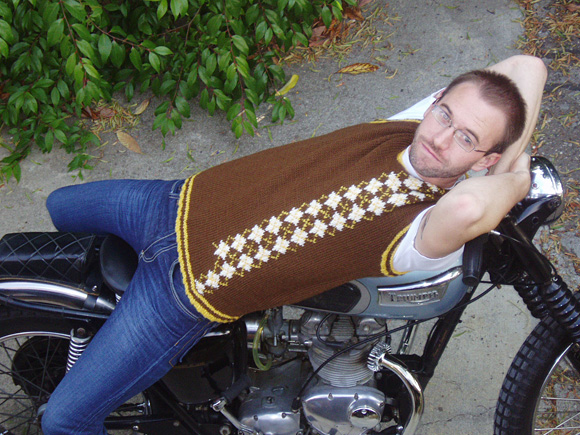
A new knitting project
Unfortunately, the acrylic I bought for my Sweetheart sweater feels nasty as a fabric, so that's on hold until I can afford some decent yarn.
So, behold the next project, for The Wife's birthday; Mangyle from the wonderful knitty.com. I'm doing the gold in a dusky pink, but otherwise I've chosen similar colours of Stylecraft Life (Ravelry link for knitters).
Wish me luck!
 Photo: Sarah Sumner-Eisenbraun on knitty.com
So, behold the next project, for The Wife's birthday; Mangyle from the wonderful knitty.com. I'm doing the gold in a dusky pink, but otherwise I've chosen similar colours of Stylecraft Life (Ravelry link for knitters).
Wish me luck!
Thursday, 15 April 2010
Life in General
Just an update on how I've been recently.
I'm leaving my job on May 22nd (eek!); it was a fixed-term position so I did know it was coming, but nonetheless I'm quite worried about finding another one.
I've been a little bit ill lately, as well, so I'm worried about what my absence record will look like.
At the moment, I suppose I'm mostly just lucky to have awesome friends who have stuck by me. Long may it last; I hope they (you, if you're reading this) understand that there are times when I'm not sure I'd cope without them. That's not additional pressure, it's a statement of fact. Just knowing they're there and that they give a crap is enough.
*cheesy American accent* I love you guys
Sunday, 11 April 2010
How to Walk Through Walls - 2 sermons
Le Passe-Muraille - The Man Who Could Walk Through Walls - Montmartre, Paris
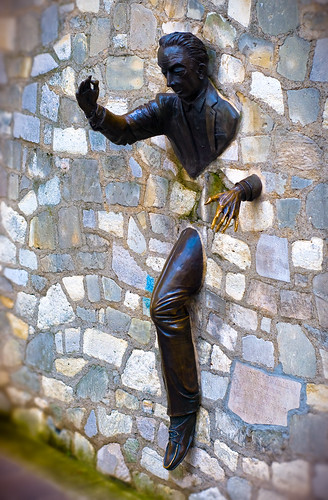
Two sermons for the price of 1! Both preached on the same day, from the same notes, but it's interesting to me that they're quite different.
Preached at Trinity United Reform Church, Camden Town, on Sunday 11th April 2010, Second Sunday of Easter.

Preached at MCC North London, Camden Town, on Sunday 11th April 2010, Second Sunday of Easter.
John 20:19-31
When it was evening on that day, the first day of the week, and the doors of the house where the disciples had met were locked for fear of the Jews, Jesus came and stood among them and said, "Peace be with you."
After he said this, he showed them his hands and his side. Then the disciples rejoiced when they saw the Lord. Jesus said to them again, "Peace be with you. As the Father has sent me, so I send you."
When he had said this, he breathed on them and said to them, "Receive the Holy Spirit. If you forgive the sins of any, they are forgiven them; if you retain the sins of any, they are retained."
But Thomas (who was called the Twin), one of the twelve, was not with them when Jesus came. So the other disciples told him, "We have seen the Lord." But he said to them, "Unless I see the mark of the nails in his hands, and put my finger in the mark of the nails and my hand in his side, I will not believe."
A week later his disciples were again in the house, and Thomas was with them. Although the doors were shut, Jesus came and stood among them and said, "Peace be with you." Then he said to Thomas, "Put your finger here and see my hands. Reach out your hand and put it in my side. Do not doubt but believe." Thomas answered him, "My Lord and my God!"
Jesus said to him, "Have you believed because you have seen me? Blessed are those who have not seen and yet have come to believe."
Now Jesus did many other signs in the presence of his disciples, which are not written in this book. But these are written so that you may come to believe that Jesus is the Messiah, the Son of God, and that through believing you may have life in his name.
Acts 5:27-32
When they had brought them, they had them stand before the council. The high priest questioned them, saying, "We gave you strict orders not to teach in this name, yet here you have filled Jerusalem with your teaching and you are determined to bring this man's blood on us."
But Peter and the apostles answered, "We must obey God rather than any human authority. The God of our ancestors raised up Jesus, whom you had killed by hanging him on a tree. God exalted him at his right hand as Leader and Savior that he might give repentance to Israel and forgiveness of sins. And we are witnesses to these things, and so is the Holy Spirit whom God has given to those who obey him."
Thursday, 25 March 2010
Palm Sunday
Originally published as a reflection in the MCC North London newsletter, 25th March 2010
This was the pinnacle of Jesus' ministry, the paradoxical moment at which his followers were rejoicing in his arrival and he was beginning to prepare for his betrayal and violent departure. To follow him at this moment, to be walking with him as his followers were spreading their cloaks out for him in the road, waving palms, shouting and praising God, must have been the most incredible privilege. For a group of poor men from small towns outside Jerusalem to be greeted like that in the holy city itself, I can't imagine how that must have felt.
There is no doubt in my mind that the Pharisees really believed that Jesus was dangerous, and I know his teachings were revolutionary. We are blessed that they did not succeed in stifling Jesus' message, nor in halting the spread of his name across the empire, but for a time it must have looked like they had succeeded.
In one short week, Jesus went from entering Jerusalem in triumph to being arrested, sentenced and publicly executed. In one short week, the followers who were so committed to him on Sunday had disappeared by Friday. They were prepared to follow him in times of joy, but were too scared to stand beside him and share the burden of his punishment. Judas betrayed him, Peter denied him, many more withdrew and pretended he had never been their leader. People felt let down, they couldn't see past the arrest and execution to realise that Jesus was still the Messiah and their saviour. Jesus knew this, and knew that he was alone on his final walk that Friday, There were people following, and mourning, but they no longer felt like his disciples - his pupils - they were weeping for their loss, for their mistaken faith in a man who was fallible. 'Jesus turned and said to them, "Daughters of Jerusalem, do not weep for me; weep for yourselves and for your children."' (Luke 30:28), he was reminding them that it was not his frailty that had led to this moment, but humanity's dark and selfish heart.
As he was now approaching the path down from the Mount of Olives, the whole multitude of the disciples began to praise God joyfully with a loud voice for all the deeds of power that they had seen, saying, "Blessed is the king who comes in the name of the Lord! Peace in heaven, and glory in the highest heaven! - Luke 19:37-38Throughout Lent we have been looking at what it means to follow Jesus and asking, what are we prepared to do for him? This week, as we head into Palm Sunday and Holy Week, we have the opportunity to follow Jesus in triumph in his final entry into Jerusalem.
This was the pinnacle of Jesus' ministry, the paradoxical moment at which his followers were rejoicing in his arrival and he was beginning to prepare for his betrayal and violent departure. To follow him at this moment, to be walking with him as his followers were spreading their cloaks out for him in the road, waving palms, shouting and praising God, must have been the most incredible privilege. For a group of poor men from small towns outside Jerusalem to be greeted like that in the holy city itself, I can't imagine how that must have felt.
It would have been a moment when it was easy to follow Jesus, when there was reflected glory to bathe in, when the disciples felt like the most important men in the world. All Jesus' followers in the city - men, women and children, from all social classes - at that moment really committed to Jesus. They were a strong group with faith; strong enough to put the wind up the Pharisees.
And so it was the turning point in the Pharisees' attitude to Jesus. They realised that he had a strong and loyal band of followers; they were scared that he threatened their monopoly on religious teaching in the city, they were scared of losing their power and influence in Jewish society. This was the moment when a group of Pharisees decided it was time to approach Herod and Pilate and tell them that Jesus was leading a band of rebels, that he threatened the stability of Roman rule in Palestine and that their only option was to arrest him as a dangerous revolutionary.
And so it was the turning point in the Pharisees' attitude to Jesus. They realised that he had a strong and loyal band of followers; they were scared that he threatened their monopoly on religious teaching in the city, they were scared of losing their power and influence in Jewish society. This was the moment when a group of Pharisees decided it was time to approach Herod and Pilate and tell them that Jesus was leading a band of rebels, that he threatened the stability of Roman rule in Palestine and that their only option was to arrest him as a dangerous revolutionary.
There is no doubt in my mind that the Pharisees really believed that Jesus was dangerous, and I know his teachings were revolutionary. We are blessed that they did not succeed in stifling Jesus' message, nor in halting the spread of his name across the empire, but for a time it must have looked like they had succeeded.
In one short week, Jesus went from entering Jerusalem in triumph to being arrested, sentenced and publicly executed. In one short week, the followers who were so committed to him on Sunday had disappeared by Friday. They were prepared to follow him in times of joy, but were too scared to stand beside him and share the burden of his punishment. Judas betrayed him, Peter denied him, many more withdrew and pretended he had never been their leader. People felt let down, they couldn't see past the arrest and execution to realise that Jesus was still the Messiah and their saviour. Jesus knew this, and knew that he was alone on his final walk that Friday, There were people following, and mourning, but they no longer felt like his disciples - his pupils - they were weeping for their loss, for their mistaken faith in a man who was fallible. 'Jesus turned and said to them, "Daughters of Jerusalem, do not weep for me; weep for yourselves and for your children."' (Luke 30:28), he was reminding them that it was not his frailty that had led to this moment, but humanity's dark and selfish heart.
I wonder how many people truly heard that message? I believe Simon of Cyrene understood, when he carried the cross for Jesus. I believe that the women who stood at the foot of the cross understood. Eventually, I know that the disciples came to understand, but they had to see the resurrected Christ first.
So when we get into Palm Sunday, remember that Jesus had this wonderful moment of triumph and glory. Remember that it is wonderful to follow Jesus when life is going well. But also take some time to think about what it means to follow Jesus when times are hard. Could we take up his cross? Could we still have faith as we watched him die? I pray that I could, and I pray that I will find the strength in times of darkness in my own life to have the strength of Simon and Mary, a faith that doesn't weaken when this world is cruel and cold.
 Jerusalem today (taken December 2008)

Subscribe to:
Posts (Atom)